


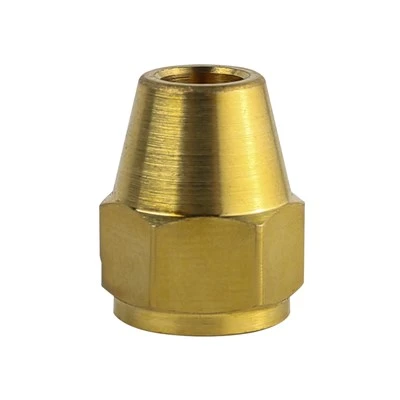
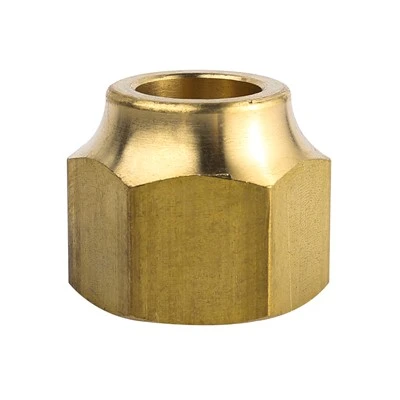
Foged Reducing Nut
Sourcing forged reducing nuts for industrial applications requires technical certainty. For procurement managers, hydraulic equipment OEMs, and international distributors, component reliability hinges on grain structure integrity, precise thread tolerances, and absolute batch traceability.
We manufacture heavy-duty forged reducing nuts engineered to withstand pressure fluctuations, mechanical vibration, and rigorous assembly cycles. By combining controlled hot/warm forging with high-tolerance CNC machining, we deliver components that eliminate fluid/gas leakage paths and optimize fluid power connections.
Technical Specifications
|
Technical Parameter |
Standard & Custom Capabilities |
|
Product Categories |
Forged Reducing Nuts, Hex Reducer Nuts, Hydraulic Thread Adapters |
|
Manufacturing Standards |
Compliant with ASME B16.11, DIN 3870 / ISO 8434, SAE J514, or Custom Blueprints |
|
Material Options |
Carbon Steel: ASTM A105, C45; Stainless Steel: SS304/304L, SS316/316L, Duplex 2205; Brass & Alloys: C36000, 4140 Alloy Steel |
|
Thread Profiles |
NPT (ANSI/ASME B1.20.1), BSPT (ISO 7), BSPP (ISO 228-1), Metric Fine/Coarse |
|
Size Range |
Imperial: 1/8" to 3" |
|
Surface Treatments |
Trivalent Zinc Plating (Cr3+), Manganese Phosphating, Black Oxide, Passivation |
|
Quality Certifications |
Mill Test Certificate (MTC to EN 10204 3.1), ISO 9001:2015 Compliant Quality System |
Engineering Advantages: Forged vs. Cast Components
Refined Grain Structure for High-Pressure Retention
Unlike cast or purely bar-machined counterparts, our reducing nuts are formed through controlled thermo-mechanical forging. Applying directional pressure to heated billets aligns the metallurgical grain flow with the external geometry of the nut.
Elimination of Internal Porosity: Forging closes internal voids and gas pockets common in castings, avoiding catastrophic failure under pressure spikes.
Enhanced Fatigue Resistance: Optimized grain boundaries significantly improve yield strength and structural integrity under cyclic thermal expansion and mechanical vibration.
Machined Thread Accuracy for Leak-Free Seals
Thread tolerance is critical to maintaining system pressure. Following the forging phase, blanks undergo precision CNC thread cutting to exact gauge specifications.
Preventing Thread Galling: Precise control over surface roughness and thread flank angles minimizes material displacement during installation.
Verified Engagement: Controlled dimensional depth ensures proper crest-to-root contact, eliminating loose connections or helical leakage paths in NPT or BSP threads.
Controlled Manufacturing & Processing Stage
Metallurgical Preparation & Forging
Production begins with raw material verification via spectrometer testing. The steel or brass billets are then heated under temperature-monitored induction systems to prevent grain growth, followed by die-forging to establish high-density component blanks.
Multi-Axis CNC Machining
Forged blanks are transferred to precise CNC turning centers. Thread forms, hex dimensions, and internal reductions are machined in single-setup operations to ensure perfect concentricity and minimize tolerance stack-up.
Surface Engineering & Passivation
Depending on the working environment, components undergo specialized surface finishing to resist corrosive attack. Stainless steel variants receive chemical passivation to restore the chromium oxide protective layer, while carbon steel parts receive heavy zinc or phosphate coatings to block environmental oxidization.
Quality Assurance & Traceability Protocol
We operate a strict quality management system designed to protect your supply chain and satisfy OEM audit standards.
Raw Material Traceability
Every production run is linked to a specific Heat Number. Mill Test Certificates (MTC) according to EN 10204 3.1 are logged and provided with shipments.
Dimensional & Thread Gauging
Hardened Go/No-Go plug and ring gauges are utilized at scheduled intervals during production to monitor thread pitch, major diameter, and flank angles.
Non-Destructive Testing (NDT)
For severe-service applications, we can provide Magnetic Particle Inspection (MPI) or Liquid Penetrant Testing (LPT) to certify subsurface defect-free integrity.
Custom Manufacturing & Bulk Supply OEM Capabilities
As a direct-to-market manufacturer, we specialize in high-volume production runs and customized component development:
DFM (Design for Manufacturability)
Our engineering team reviews your 2D/3D technical drawings (CAD, STEP, PDF) to optimize tolerances and machining efficiency before toolmaking.
Private Labeling & Serialization
Component marking via laser etching or stamping for heat numbers, sizing, and client branding.
Export-Grade Packaging
Threaded faces are protected via heavy-duty plastic caps, batch-packed in oil-resistant polythene bags, and secured in reinforced wooden crates or palletized cartons for sea and air freight.
FAQ
Hot Tags: foged reducing nut, China foged reducing nut manufacturers, suppliers, factory, 45 degree brass union fitting, angled pvc fittings, SAE flare short rod nut, 30 degree plastic plug fitting, angled food grade fittings, 45 degree stainless valve fitting
Previous
No InformationNext
Short Rod NutYou Might Also Like



Send Inquiry